Santorini is beautiful. It is also, for much of the year, spectacularly overcrowded — cruise ships disgorging thousands of visitors daily into caldera-view restaurants charging thirty euros for a glass of wine, the narrow paths between whitewashed buildings becoming impassable by mid-morning. Greece has over two hundred inhabited islands. These five are the ones worth choosing instead: each one with its own distinct character, its own reasons to go, and none of them requiring you to book eighteen months in advance or share a sunset with two thousand strangers.
The largest of the Cycladic islands and, by some measures, the most self-sufficient — Naxos grows most of its own food, produces its own olive oil, cheese, and potatoes, and has been doing so since before tourism arrived. The beaches on the western coast are long, sandy, and sheltered, with water that grades from turquoise to deep blue in the afternoon light. The interior is mountainous and largely unvisited: marble-quarried villages, Byzantine churches, Venetian towers, and a landscape that looks nothing like the Greece of travel brochures.
Don't miss: The Portara — a giant marble doorway from an unfinished temple to Apollo, standing alone on a promontory at the entrance to Naxos Town, framing the sunset with no competition. The mountain village of Apeiranthos, built entirely from marble, whose inhabitants speak a dialect unlike any other Greek. And the cheese — graviera from Naxos is one of the great cheeses of the Mediterranean and available everywhere on the island for a fraction of what it costs anywhere else.
Greece Travel Guides on Amazon →Ikaria is one of the world's five Blue Zones — places where people routinely live past a hundred — and the island's approach to time is genuinely different from anywhere else in Greece. Restaurants open when they open. Ferries are suggestions. Festivals called panigiri happen without much notice, starting at midnight and running until dawn, with local wine and dancing that the whole village attends regardless of age. The landscape is rugged and dramatic, the beaches are wild and largely unsignposted, and the locals are famously indifferent to the rhythms of mass tourism in a way that feels like a gift rather than a slight.
Don't miss: The thermal springs at Therma — radioactive hot springs that have been used since antiquity, where you can soak in mineral-rich water that flows directly into the sea. The village of Christos Raches, which operates on a night schedule — shops open at midnight, close at dawn — a relic of the island's history of piracy when it was safer to live by night. And the local red wine, served from unmarked jugs and considerably stronger than anything you've been warned about.
Greece Travel Guides on Amazon →Hydra has no cars, no mopeds, and no motorised vehicles of any kind. Everything moves by foot, by donkey, or by water taxi. The effect on the quality of the air — and the quality of the silence — is extraordinary, and the island has attracted artists, writers, and people who need to think clearly since at least the 1960s, when Leonard Cohen lived here and wrote some of his early songs. The harbour is one of the most beautiful in the Mediterranean, ringed by eighteenth-century stone mansions built by ship captains who made their fortunes in the Ottoman trade routes, and the walking paths into the interior lead to monasteries, swimming rocks, and views that go on for miles.
Don't miss: Swimming off the rocks at Spilia, the unofficial swimming spot a fifteen-minute walk from the harbour where locals have been going for generations. The monastery of Profitis Ilias at the top of the island — a two-hour walk from the harbour, mostly uphill, entirely worth it. And the donkeys, who have the right of way on every path and know it completely.
Greece Travel Guides on Amazon →Folegandros is tiny — twelve kilometres long, three kilometres wide — and has been deliberately resistant to the kind of development that overwhelmed its Cycladic neighbours. The main town, known as the Chora, sits on a clifftop above the sea and is considered by many Greeks to be the most beautiful village in the Cyclades: a labyrinth of flower-filled squares and narrow lanes with no signage, designed that way historically to confuse pirates. The beaches require effort to reach — some only accessible by boat — which means they remain genuinely uncrowded even in August.
Don't miss: The walk from the Chora to the Church of Panagia, perched on the highest point of the cliff above the sea — the path is steep and the view at the top is among the best in the Aegean. The beach at Katergo, reachable only by boat from the port, with water that photographers routinely describe as the clearest in Greece. And the Chora itself at night, when the day-trippers have left and the squares fill with locals.
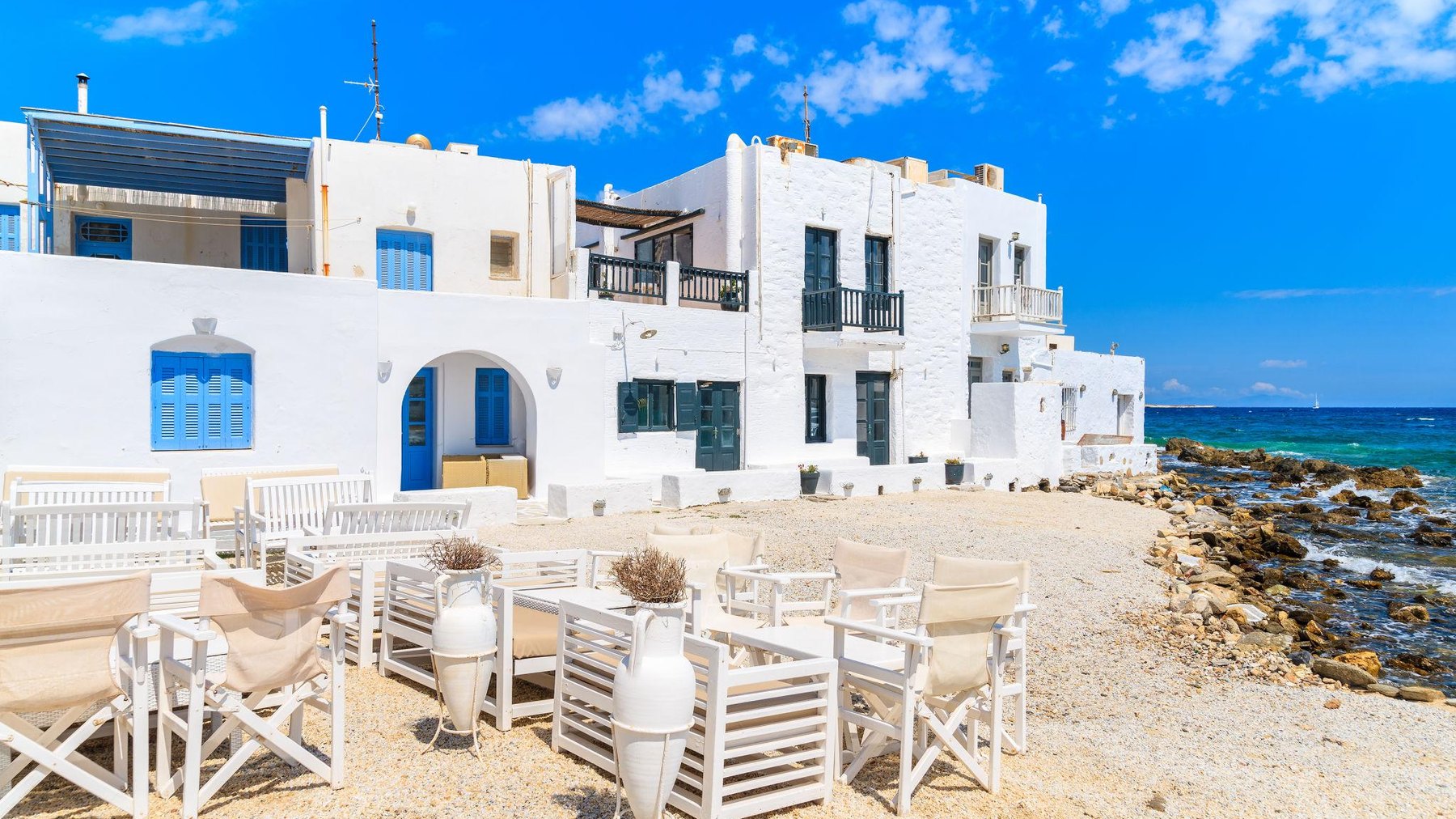
Greece Travel Guides on Amazon →Paros occupies the middle ground between the busier Cycladic islands and the more remote ones — lively enough to have genuine nightlife and a range of restaurants, quiet enough that you can find a beach to yourself within twenty minutes of the main town. The island's marble has been famous since antiquity — the Venus de Milo and much of the Parthenon were carved from Parian marble — and the quarries are still visible in the island's interior. Naoussa in the north is one of the most charming fishing villages in the Aegean, its Venetian harbour small enough to feel intimate even in summer.
Don't miss: The Panagia Ekatontapyliani — the Church of a Hundred Doors, one of the oldest and best-preserved Byzantine churches in Greece, sitting in the middle of Parikia with a calm that the surrounding town doesn't always match. The beach at Kolymbithres, whose granite formations have been sculpted by centuries of wind and water into shapes that look deliberate. And the ferry to Antiparos — twenty minutes from Paros, a fraction of the visitors, and beaches that justify the detour completely.
Greece Travel Guides on Amazon →BONUS
Crete is large enough — and varied enough — that it operates by different rules from the rest of this list. The island is 260 kilometres long, has its own dialect and its own cuisine and its own distinct identity that predates Greek civilisation itself, and contains within it enough variation to fill several separate trips. The north coast has the package tourism; everything else — the White Mountains, the Samaria Gorge, the southern coast villages accessible only by boat, the Minoan ruins at Knossos, the old Venetian harbour at Chania — is spectacular and relatively manageable even in peak season if you move away from the obvious.
Don't miss: The Samaria Gorge — sixteen kilometres of walking through the longest gorge in Europe, emerging at the sea — one of the great walks in Greece. The village of Loutro on the south coast, accessible only by boat or a long mountain path, with no cars and one of the best fish restaurants in the Aegean. And Cretan food, which is its own subject: dakos, lamb slow-cooked in wine, honey from thyme-covered hillsides, olive oil that makes everything else taste thin.
Crete Travel Guides on Amazon →